The investment pressure on schools is real: devices from the first Digitalpakt are reaching the end of their life cycle, networks are hitting their limits and the demand for interactive displays keeps growing. At the same time, the money from Digitalpakt 2.0 has not yet reached the vast majority of school authorities. In this article we explain calmly why the funding approvals are stalling, from the budget freeze through the administrative agreement to the missing funding guidelines of the federal states, and show what you as a school authority or IT lead can already prepare despite the waiting period.
Budget freeze and provisional budget management – what the terms mean
To understand why funding stalls, you need to distinguish two budgetary mechanisms. A budget freeze (Haushaltssperre) is the full or partial blocking of already budgeted spending by the responsible finance ministry. It serves to limit new commitments or to secure compliance with the debt brake. Often it is above all new commitment authorisations that are stopped, that is, the power to make binding payment commitments for future years. This hits multi-year funding programmes at their core.
Provisional budget management (vorläufige Haushaltsführung), by contrast, is not a political instrument but a constitutionally regulated automatic mechanism under Article 111 of the German Basic Law. It applies as soon as no budget act is in force at the start of a budget year. During this phase the federal government may only make expenditures needed to maintain existing institutions, continue measures already decided or fulfil legally founded obligations. The Federal Court of Audit stresses that such expenditures are only permissible if they are suitable, materially necessary and cannot be postponed in time.
For new programmes, and Digitalpakt 2.0 is a new programme, this means a high burden of justification. The federal government itself stated for 2025 that new projects were harder to start in this phase and only possible where they were materially and temporally indispensable. Existing approvals, for example from Digitalpakt 1.0, may continue; new approvals, however, are heavily restricted. This is the first reason why fresh money does not simply flow.
Why so many funding approvals are currently outstanding
Today's situation has a clear starting point. On 15 November 2023 the German Federal Constitutional Court declared the Second Supplementary Budget Act 2021 void (ref. 2 BvF 1/22) and prohibited the transfer of around 60 billion euros of unused coronavirus credit lines into the Climate and Transformation Fund. With that, the permissible net borrowing was exceeded, and the federal government responded with a far-reaching budget freeze and a complete reworking of the budget.
This upheaval still has effects today. Special funds had to be recalibrated and scope tightly aligned with the debt brake, which delayed the planning of new infrastructure programmes including the digitalisation of schools. On top of that came the 2025 budget situation: at the start of the year no adopted budget was in place, so provisional budget management applied from 1 January 2025. For many programme expenditures, only around 45 percent of the planned funds were usable in this phase.
The 2025 Budget Act was not promulgated until 2 October 2025, retroactively to 1 January 2025. Until then, new programmes such as Digitalpakt 2.0 could only be started in a binding way if they were deemed indispensable, which was interpreted narrowly in budgetary terms for school IT. The underlying pattern is general: as long as there is no final budget and no released budget lines, new funding programmes can only be started to a very limited extent. This explains why not only the Digitalpakt but many approvals are stuck at the same time.
Digitalpakt 2.0 – what has been decided and where it is stuck
In substance, Digitalpakt 2.0 is well advanced. On 13 December 2024 the federal government and the states issued a joint declaration: the programme is to be designed as an overall concept for the digitalisation of schools with a term of 2025 to 2030. A total of 5 billion euros is planned, borne equally by the federal government and the states, that is 2.5 billion euros each. According to the Federal Ministry of Finance, the federal share consists of 2.25 billion euros from a special infrastructure fund and 250 million euros for the programme „Digital Teaching and Learning“.
Structurally, the pact rests on three interlocking strands of action: infrastructure (networks, servers, end devices, interactive boards and displays), IT administration and operation, and pedagogical and didactic measures plus training. The legal basis is to be an administrative agreement under Article 104c of the Basic Law. In the 2026 federal budget, adopted by the cabinet on 30 July 2025, the funds are earmarked, so the financing is in place in principle.
Why the money is still not flowing
For money to reach a school authority, two conditions must be met: the administrative agreement must be signed by the federal government and all 16 states, and the respective state must have published its funding guideline with the application procedure, quotas and priorities. As of June 2026, neither is comprehensively complete.
North Rhine-Westphalia announced on 21 April 2026 that it had adopted the agreements as one of the first states, while noting that Digitalpakt 2.0 only enters into force once all states have signed. The earliest possible start of measures was set at 1 January 2026. In short, Digitalpakt 2.0 is politically agreed and budgeted, but the practical allocation of funds to school authorities is stalling because the administrative agreement has not yet been ratified everywhere and many states have not yet published their funding guidelines.
The dispute over the funding start: 2025 or 2026?
One point in particular is being fought over hard, and it decides over real money. Originally the pact was to start retroactively on 1 January 2025 in order to avoid a funding gap after Digitalpakt 1.0 expired. Federal Education Minister Karin Prien explicitly stressed the retroactive start to secure follow-on financing. On the strength of this commitment, many municipalities already invested in 2025, in end devices, whiteboards and infrastructure.
In the more recent version of the administrative agreement, however, the funding start was moved to 1 January 2026. The reaction was clear: the German Association of Cities, the German County Association and the German Association of Towns and Municipalities jointly criticised at the end of March 2026 that the federal government had moved the start date without prior consultation with the municipalities. Many municipalities had invested in good faith on the basis of the commitment and would now be left sitting on the high costs, an approach the associations regard as a breach of legitimate expectations. The German Philologists' Association likewise accused the federal government of unilaterally shifting the funding start.
It remains contested and open whether there will be a solution that retroactively makes at least part of the municipal investments made in 2025 eligible for funding. The associations demand a return to the start on 1 January 2025; a final, nationwide rule is not documented as of June 2026. For school authorities this means that for spending made in 2025 a refinancing risk remains for the time being.
What the stalemate means for school IT procurement
Between the end of applications for Digitalpakt 1.0 in mid-May 2024 and the regular launch of Digitalpakt 2.0, a funding gap has effectively opened up. Ongoing legacy projects may still be settled, Digitalpakt 1.0 can be accounted for until the end of 2025 and, for cross-state projects, until the end of 2026, but new projects can no longer be backed by the old programme. The result is noticeable planning uncertainty. In practice this shows up in three effects:
- Stopped or split tenders: School authorities postpone larger IT packages such as comprehensive display fit-outs, WLAN and network renewal or server rooms, or break them into smaller lots, because it is unclear whether and when funds will flow.
- Reduction to replacement and emergency purchases: As with earlier municipal budget freezes, in many cases only urgently necessary purchases and repairs are commissioned; strategic modernisation waits.
- Investment backlog in hardware: Renewing the device fleets purchased between 2019 and 2021 is hard to finance, and second equipment waves such as additional displays for new rooms or extensions of board systems are put on hold.
That this pattern is real is shown by the first Digitalpakt: of 6.5 billion euros in federal funds, 97 percent had been approved by mid-2024, but only around 3.4 billion euros had actually been disbursed, an indication of how long infrastructure projects remain stuck in tendering and implementation phases. It is precisely these long lead times that make the current waiting phase so critical: anyone who only starts planning after approval loses valuable months.
What school authorities and IT leads can prepare now
The good news: the waiting time can be used productively. Much of what determines the speed of a later rollout costs no funding now, only preparation. And experience from Digitalpakt 1.0 shows that the flow of funds stalled above all where an inventory and strategic planning were missing.
- Inventory and needs planning: Record the current state of your IT infrastructure, that is networks, WLAN, end devices, board and display systems and server rooms, and derive a priority list ordered by urgency.
- Check eligibility in advance: Assign planned measures to the three strands of action now, namely infrastructure (displays, smartboards, network technology), IT operation and administration, and training and pedagogy. This makes it easier to translate projects into eligible packages later.
- Prepare procurement, without commitment: Needs assessments, market surveys and drafts of tender documents are possible even without released funds. Draw up specifications for typical packages and define the procurement strategy.
- Keep residual funds and state guidelines in view: Clarify with your state whether residual funds or reallocations from Digitalpakt 1.0 are still possible, and watch closely for the publication of the state funding guidelines.
How to use the waiting time for a ready-to-go rollout
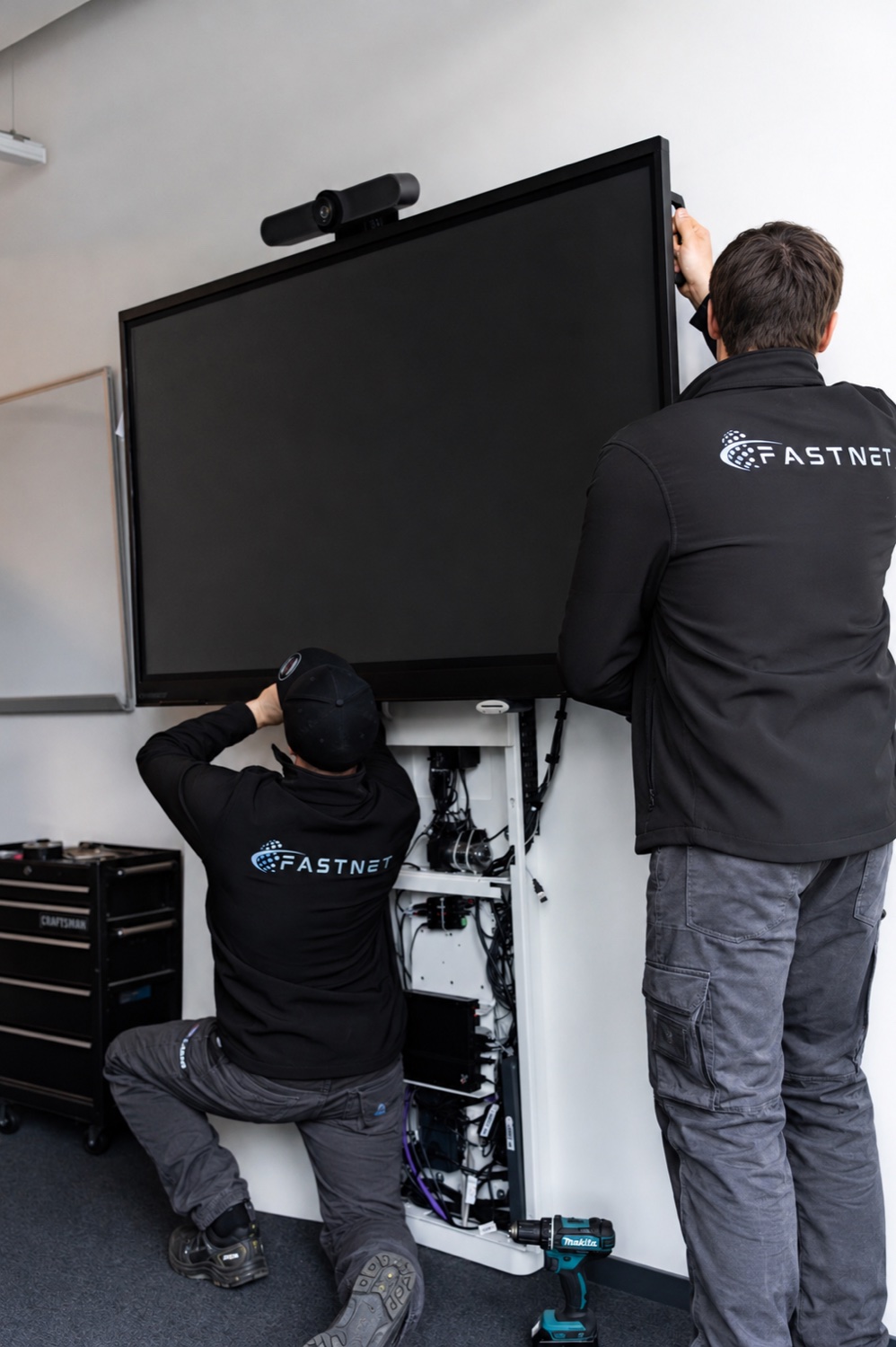
A considerable part of the implementation time is spent not on procurement but on the physical execution on site, and that can be prepared. Clarify early the structural and electrical prerequisites per room: wall condition and load capacity, power and data connections, cable routes. Especially in existing buildings, these are the points where rollouts later stall. How we secure installation and commissioning in existing buildings is explained in our article on smartboard installation in existing buildings.
Anyone who factors in installation capacity now, including a reliable partner for site survey, installation, commissioning and handover documentation, can move into the field without start-up losses after funding is released. FASTNET supports school authorities precisely in this ready-to-go phase: with an on-site needs survey, an assessment of the structural prerequisites and plannable, documented installation, nationwide and on request in white label for your system house. An overview of all services can be found in our services section.
Key points at a glance
Digitalpakt 2.0 has been decided with 5 billion euros for 2025 to 2030 and is anchored in the 2026 federal budget, yet the funds have not reached school authorities: the administrative agreement has not been signed by all states, many state funding guidelines are missing, and the funding start is disputed between 2025 and 2026. The result is planning uncertainty and an investment backlog for displays, smartboards and network technology. School authorities that now prepare an inventory, needs planning and procurement will be ready to go immediately once funding is released.
Checklist – how to be ready once the funds are released
This checklist helps you keep the most important preparatory work in view:
- Current state of the IT infrastructure recorded: networks, WLAN, end devices, board and display systems, server rooms
- Needs list prioritised by urgency (renewal, expansion, new build)
- Measures assigned to the strands of action infrastructure, operation and pedagogy
- Specifications for standard packages prepared
- Procurement strategy defined (lot structure, framework agreements, bidder requirements)
- Structural and electrical prerequisites checked per room (wall, power, data, cable routes)
- Residual funds from Digitalpakt 1.0 and settlement deadlines clarified with the state
- State funding guideline monitored (own contribution, priorities, application deadlines)
- Implementation partner for installation and commissioning pre-arranged
Frequently asked questions about Digitalpakt 2.0 and the budget freeze
About the author

Kim Fabig
Managing Director | Technical Lead
FASTNET GmbH