The digitalisation of teaching meets, in many schools, building fabric from decades when asbestos was still widely used in construction. Anyone mounting a smartboard on the wall of an existing building may be drilling into plasters, fillers or panels that could be contaminated. This is precisely where technical expertise determines whether an installation complies with legal and occupational-safety requirements.
Digital teaching meets old buildings: the tension
The demand for digital board systems has been growing for years, driven by funding programmes, revised curricula and rising expectations of modern teaching. Smartboards, interactive displays and pylon systems are meant to go up quickly, ideally during the holidays and without long teaching disruptions.
Many school buildings, however, date from construction phases in which asbestos-containing materials were standard. At the time, asbestos was found in plasters and fillers, in facade and fire-protection panels, in floor and ceiling coverings and in adhesive layers. As long as these materials remain undisturbed, they generally pose no acute hazard.
The problem arises the moment an intervention takes place. Drilling, milling or cutting into a wall can release bound fibres and disperse them into the indoor air. In an older building, a smartboard installation is therefore never merely a manual task; it is always also a matter of occupational health and safety, both for the installation crew and for pupils and teaching staff.
On top of this comes organisational pressure. Funding deadlines are expiring, the devices have been delivered, the caretaker is waiting, and ideally everything should be done within a short holiday window. In this mix, the question of the substrate easily fades into the background. That is exactly the moment when a routine installation turns into an avoidable risk. We therefore deliberately place the asbestos question ahead of the schedule and resolve it before the first drill is applied.
Asbestos basics for school authorities and IT leads
Asbestos is a collective term for naturally occurring, fibrous minerals. Because of its heat resistance, strength and good insulating properties, it was used for decades in thousands of construction products. In Germany its use has been banned since 1993, but the entire building stock predating this can be affected.
Asbestos becomes dangerous when fibres are released and inhaled. The fine particles can lodge in the lungs and, over the long term, trigger serious illnesses, including asbestosis, chronic lung diseases and certain forms of cancer. A characteristic feature is the long latency period: symptoms often appear only decades after exposure. This is exactly what makes a precautionary, proper way of working so important.
For schools the relevance is high, because a large share of the building stock dates from the affected construction years. Typical suspect components are plastered interior walls with asbestos-containing fillers, facade and window-parapet panels, fire-protection cladding and older floor and ceiling coverings together with their adhesives. This is not about scaremongering but about a sober fact: in a building of unclear construction age, the asbestos question must be clarified before drilling.
It is important to distinguish between firmly bound and weakly bound asbestos products. Firmly bound materials, such as many asbestos-cement panels, release hardly any fibres when undisturbed but can still cause contamination when drilled. Weakly bound products, such as certain sprayed coatings or lightweight panels, are considered especially critical because they release fibres even under minor mechanical stress. Which variant is present in a wall cannot be reliably identified from the outside; only a technical investigation provides clear certainty.
Legal requirements: TRGS 519 and certified expertise
In Germany, the legal framework is set by the German Hazardous Substances Ordinance (Gefahrstoffverordnung), made concrete by the Technical Rules for Hazardous Substances. For asbestos, the German technical rule TRGS 519 is decisive. It governs how demolition, refurbishment and maintenance work on asbestos-containing materials must be carried out, and it defines which qualifications those involved need.
A central point: certain activities on asbestos-containing materials may only be carried out, or be led under responsibility, by persons with proven certified expertise (Sachkunde). This expertise is taught in officially recognised courses, with different course requirements applying depending on the type of activity (described in TRGS 519 through Annexes 3 and 4). The proof of certified expertise (Sachkundenachweis) is time-limited and must be refreshed regularly through further training, usually within six years.
Responsibility always rests with the employer, that is, the executing company. It must ensure that the respective responsible person holds the required certified expertise, that a risk assessment is prepared, and that the protective measures of TRGS 519 are observed. For school authorities this means: anyone awarding installation work in existing buildings should actively demand these requirements rather than tacitly assume them.
Where the line runs between simple installation and asbestos work
Not every drilling operation in a school wall is automatically asbestos work. Uncritical scenarios are those in which the substrate is demonstrably asbestos-free, for example through a current report or asbestos register, or in which the area has been classified as harmless after technical examination and clearance. In these cases, a professional standard installation is possible.
It becomes critical as soon as there is a justified suspicion of asbestos-containing materials, for instance contaminated plasters, fillers or facade panels, and this suspicion has not been dispelled. Then one must not simply drill. Instead, the situation must first be clarified, and where necessary a specialist firm with certified asbestos expertise must be brought in to plan and carry out the work in line with TRGS 519. The rule of thumb is: when in doubt, clarify first, then work.
The line therefore does not run along the question of whether a smartboard is being mounted, but along the material into which the intervention is made. An identical wall installation can be an uncritical standard service in one building and, in another, an activity requiring certified expertise and special protective measures. This is exactly why experience with installation technology does not replace clarifying the substrate; both must come together.
Typical mistakes in smartboard installations in existing buildings
In practice, risks rarely arise from ill intent, but from time pressure and a lack of coordination. The most common mistakes:
- Drilling without clarifying the asbestos situation: work begins without checking the construction year, asbestos register or an available report.
- Lack of coordination between those involved: the school authority, the building department and the executing system house or installation partner do not talk to one another, and responsibilities remain unclear.
- No documentation: clearance measurements, clearances or a written record of the basis on which drilling took place are missing.
- Blanket assumption of being asbestos-free: the substrate is treated as harmless without evidence, even though the construction age would warrant an investigation.
An anonymised example from our project practice shows how to do it right: for fitting out several classrooms in a school building from the older construction years, we coordinated with the responsible building authority before installation. As there was no clear statement on the absence of asbestos for individual wall areas, an asbestos-experienced specialist firm was brought in, which professionally assessed and cleared the affected fixing points. Only afterwards were the displays installed, fully documented and with no risk to school operations.
How FASTNET plans smartboard installations safely in old buildings
We do not treat the asbestos question as a special case but as an integral part of our project preparation in existing buildings. Our approach follows a standardised procedure:
- Advance clarification with the school authority and building authority: we ask about the construction year, existing asbestos registers and reports, and jointly determine whether the affected components can be considered clarified.
- Bring in specialist expertise when in doubt: if the asbestos situation remains unclear, we involve a specialist surveyor or a firm with certified asbestos expertise before any drilling takes place.
- Adapt the installation concept: where necessary, we choose alternative fixing solutions, use existing load-bearing systems or relocate drilling points to avoid intervening in critical components.
- Documented execution: the basis, clearances and fixing are recorded transparently, so that school authorities have reliable documentation in hand.
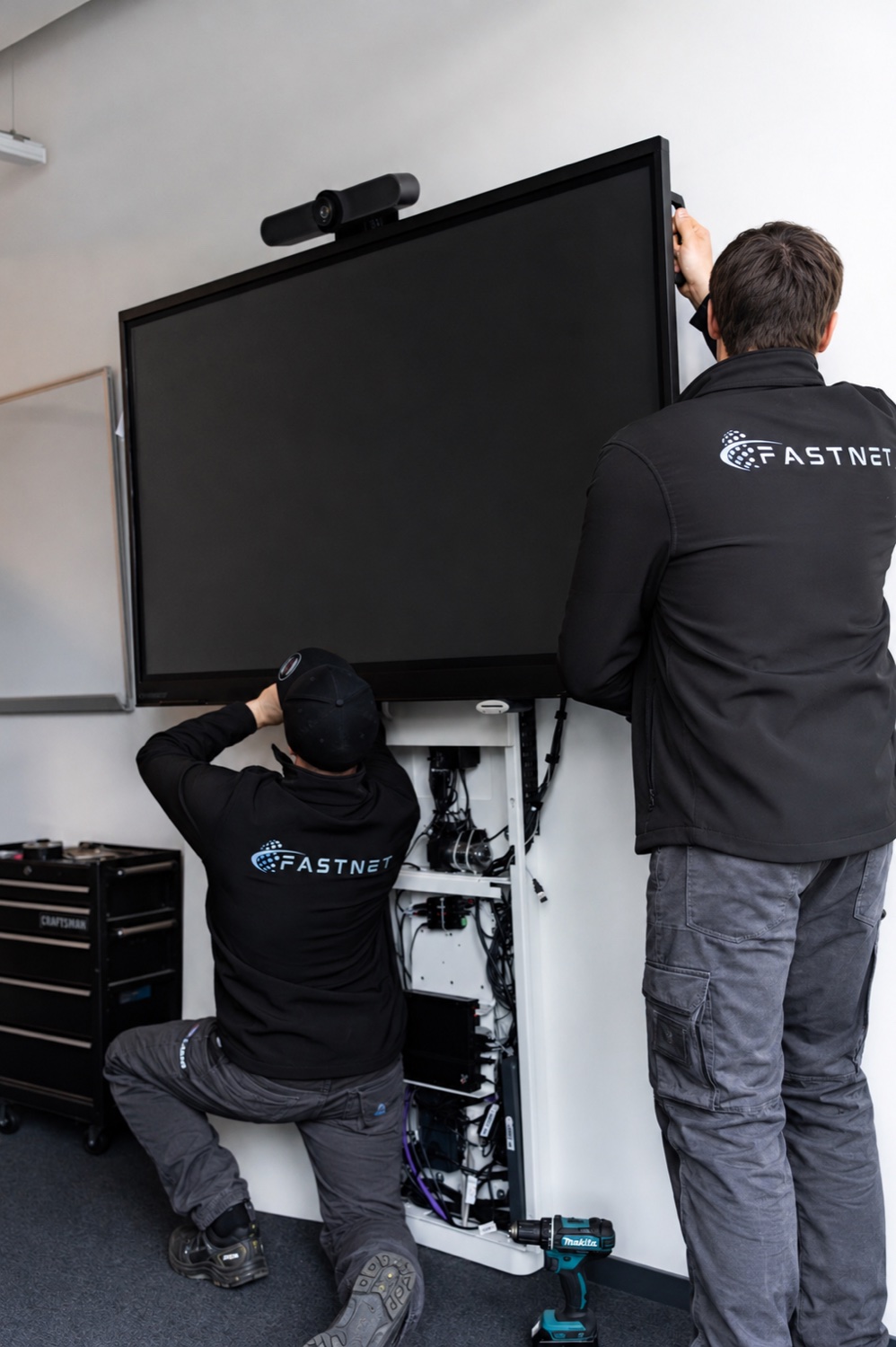
This diligence works because we operate nationwide to the same standardised procedures. Through our Germany-wide network of technicians, we bring experience from numerous installations, from pylon systems to classic wall mountings, and can deliver a professional, DGUV-compliant solution even in structurally demanding existing buildings. If you would like to learn more about how we work, you will find an overview on our system house page.
Technical planning: loads, anchors, substrates
Beyond the hazardous-substances question, structural planning determines a permanently safe installation. Depending on their size, interactive displays and pylon systems carry considerable weight that must be transferred safely into the substrate. Which fixing is load-bearing depends directly on the wall construction.
In solid substrates such as concrete or masonry, different anchor types and fixing spacings are used than in plasterboard or drywall walls, which often require a sub-construction or a continuous fixing into the load-bearing structure behind. We assess the substrate, loads and suitable anchor systems in advance rather than improvising at the device. One important point remains, however: in asbestos-critical walls, drilling is carried out only after a risk assessment and clearance. You will find an overview of our installation services under Services.
What school authorities should do in concrete terms
School authorities and municipal building departments can significantly reduce the risk by establishing a few clear points. This checklist helps with preparation:
- Check the asbestos register and reports for the affected building and have them updated if necessary.
- Before every drilling operation, clarify the construction year and the specific wall construction of the installation areas.
- Define clear processes and responsibilities for drilling work in existing buildings.
- Include requirements for certified asbestos expertise, risk assessment and documentation in tenders.
- Appoint a central point of contact to coordinate between the building department, the school and the installation partner.
- Document and archive clearances, clearance measurements and the fixings carried out in a traceable way.
When in doubt: clarify first, then drill
Never drill in existing buildings without a clarified asbestos situation. If no current report or asbestos register is available and there is a justified suspicion, the work must be stopped and the situation assessed by qualified experts. Later remediation of released fibres is many times more costly than careful advance clarification.
Frequently asked questions about asbestos in smartboard installations
About the author

Kim Fabig
Managing Director | Technical Lead
FASTNET GmbH