Hardly any publication is quoted as often in German school administrations, and read as rarely, as DGUV Information 202-021 "Sichere Schultafeln" (Safe School Boards), issued by the DGUV, Germany's statutory accident insurance umbrella organisation. In just twelve pages it gives very concrete answers: which board systems are covered, which inspections are due when, what is examined, and who is allowed to do it? We work through the publication systematically: inspection types, checkpoints, documentation, liability and practice.
What is DGUV Information 202-021 and which systems does it cover?
DGUV Information 202-021 "Sichere Schultafeln" (Safe School Boards) is published by the Deutsche Gesetzliche Unfallversicherung (DGUV), the German statutory accident insurance; the current edition dates from February 2020, its predecessor was GUV-SI 8016. Building on the German Ordinance on Industrial Safety and Health (Betriebssicherheitsverordnung, BetrSichV), it spells out the regular mechanical and electrical inspection of school boards and interactive board systems; the public-sector accident insurers (Unfallkassen) treat it as an established expert opinion. It applies to schools and other rooms for education and training, such as lecture halls.
It covers all board types commonly found in schools:
- Folding sliding boards with wall and/or floor fixing: the classic school board with counterweight system, total weight around 300 kilograms.
- Pylon boards with lateral columns: lower wall load, also suitable for lightweight walls.
- Mobile boards: movable systems, frequently folding sliding boards on a castor base.
- Interactive whiteboards: board, projector, support frame with height adjustment, sometimes with folding wings.
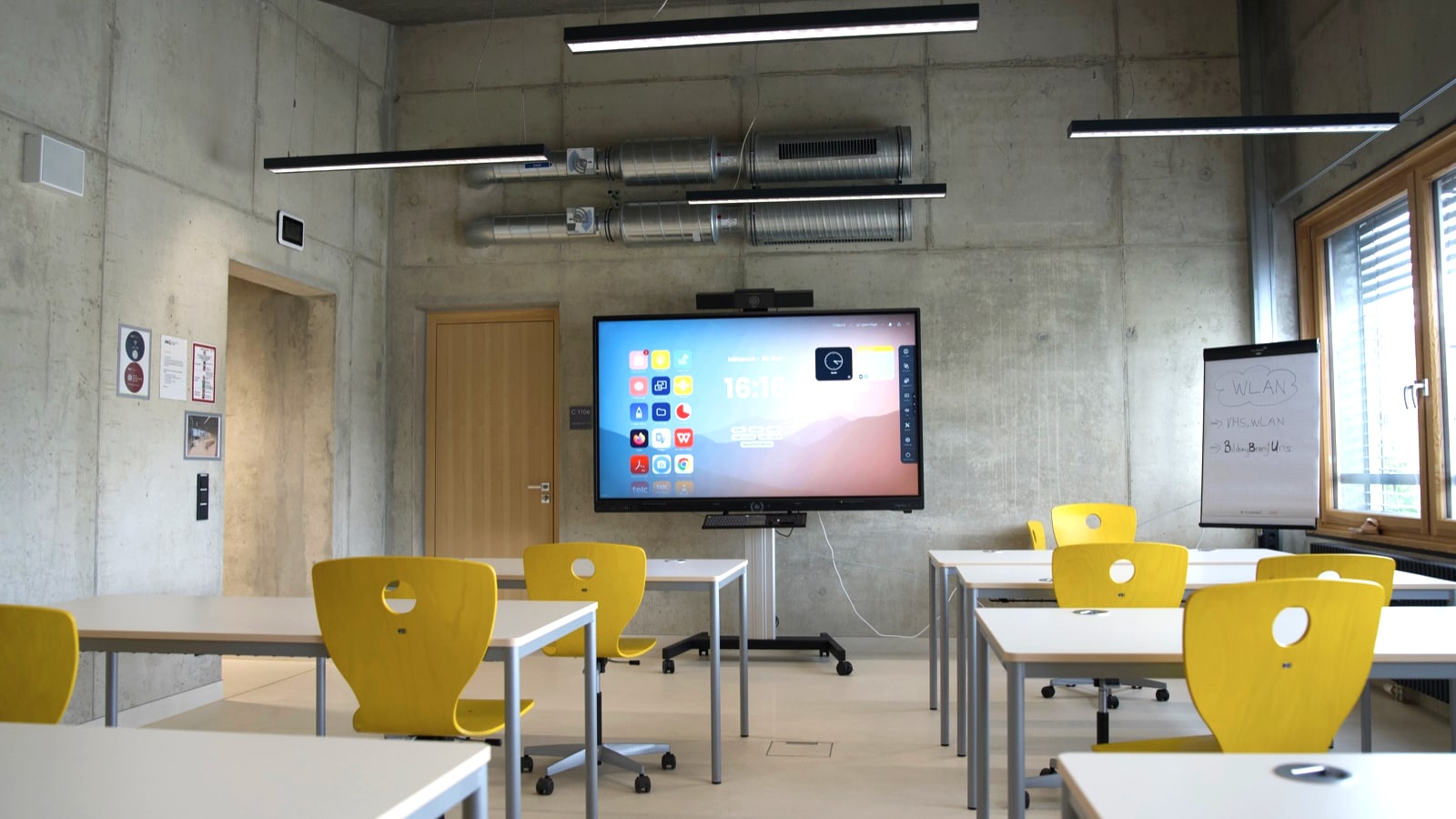
- Interactive displays: touchscreens with integrated electronics.
According to the publication, interactive board systems have wall fixings and support structures similar to chalkboards and belong in the same inspection and maintenance logic; a display simply extends the inspection duty by the electrics. For an overview from the school authority's perspective, see our article on the DGUV inspection of board systems; here we focus on the publication itself.
Inspection types and intervals: from the usage check to the main inspection
The publication distinguishes several inspection levels that build on one another:
- Usage check at every use: teachers watch for damage such as a tilted board body, stiff height adjustment or unusual noises and report it to the school management; serious defects such as a loosened wall fixing require immediate safeguarding measures.
- Visual and functional inspection at short intervals: detects obvious defects; the inspector is usually the caretaker with craft training and instruction. An interval of 1 to 3 months has proven practical, monthly only where needed, for example after vandalism, to avoid inspection fatigue.
- Annual main inspection: under Section 14 BetrSichV, a competent person inspects recurrently; for boards in typical classrooms the annual cycle is considered appropriate, and the risk assessment may permit longer intervals for modern pylon boards or in adult education. The inspection goes deep: visual condition, function and load of all components including chains, cables, bearings and counterweights, where necessary with inspection covers opened.
Interactive board systems additionally need a regular electrical inspection by a qualified electrician, with intervals depending on design and risk assessment: fixed installations roughly every 4 years in practice, while for portable equipment the operator sets the interval, frequently annually. The Unfallkasse Mecklenburg-Vorpommern lists school boards as work equipment subject to inspection with an interval of one year.
The specific checkpoints in detail
The checklists in the publication's annex structure the inspection by assemblies, with fields for "defect" and "remark/measure". Four areas take centre stage:
- Wall, ceiling and floor fixing: screw and anchor connections checked for loosening, cracks and correct execution per the manufacturer's instructions; attention goes to lightweight and old-building walls with crumbling mortar, where load spreaders, anchor bolts or special plugs may be needed.
- Writing surface and frame: cracks, chipping, damaged glass surfaces, missing protective caps on corners and rails, water damage from cleaning water.
- Board body and wings: loosened screw connections to the sliding mechanism, opened corner joints of old wooden casings, shear and crushing points, inadequate safety chains on tilting wings.
- Sliding mechanism, bearings and counterbalance: rollers, bearings, chains or steel cables and pulleys; metallic abrasion counts as a wear indicator. The end stops at top and bottom must engage so that board bodies and counterweights do not strike hard; stiffness and squeaking point to wear that can progress to failure.
For mobile boards the publication is explicit: the stability determined under DIN EN 14434 or DIN EN 1023-3 provides no sufficient protection against tipping in the event of misuse, for example when pupils hang on the wings; mobile boards therefore need an additional wall restraint such as a chain or strap, which is checked as well.
Additional checkpoints for interactive board systems
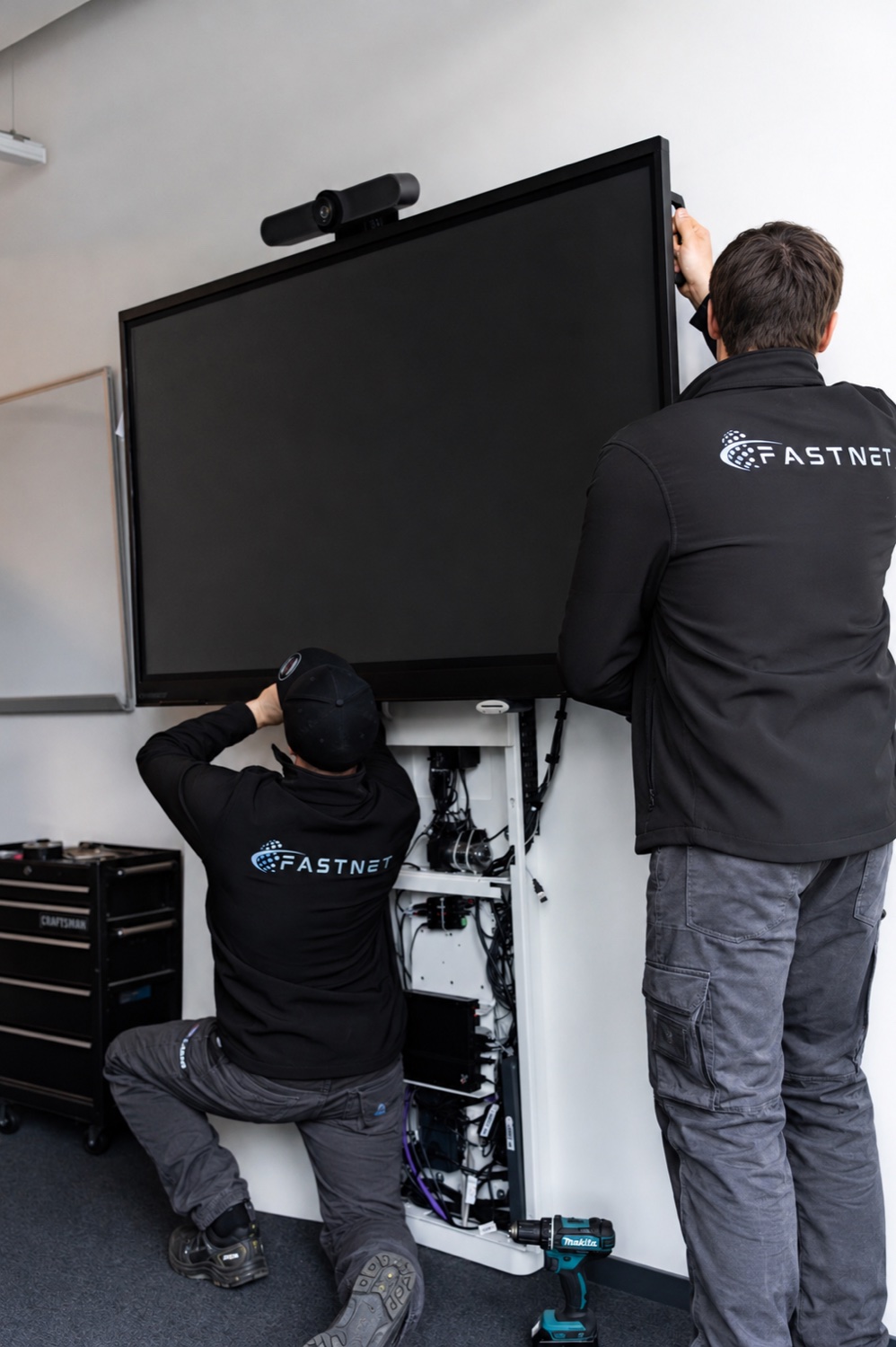
- Wall fixing of the board or display: screws, mounting brackets, support frame.
- Attachments: projector and projector arm, hinges, fixings of optional board wings.
- Height adjustment: bearings and rollers, smooth running without excessive play.
- Electrics: visual check for damaged cables, plugs, loose cable fixings and housing damage, plus the recurrent electrical inspection.
The fixing check shows how closely board safety and building fabric are linked; the role that wall build-up and construction era play during installation is explored in our article on smartboard installation in existing buildings with suspected asbestos.
Who may inspect: the competent person under TRBS 1203
The annual main inspection is reserved for a "person competent to inspect" (zur Prüfung befähigte Person); the BetrSichV and the technical rule TRBS 1203 define this via three pillars:
- Vocational training: a completed technical qualification appropriate to the inspection task, for example as a metalworker, joiner, mechatronics technician or certified technician.
- Professional experience: practical experience with comparable work equipment; typical damage patterns, mode of operation and safety-relevant influences must be familiar.
- Recent activity: ongoing inspection practice with several inspections per year and regular further training on the BetrSichV, DGUV rules and DIN standards.
Suitable tools, measuring equipment, gauges and manufacturer documents are also required. For work equipment with electrical components, TRBS 1203 additionally demands an electrotechnical qualification or a degree in electrical engineering plus at least one year of experience with electrical equipment.
This must be distinguished from the visual and functional inspection during the year: no particular professional requirements under TRBS 1203 apply to it, but instruction is required; caretakers and teachers play their part without being competent persons. The formal appointment rests with the school authority as the employer, in writing and with clearly defined powers. This can be staff of specialised firms or internally trained employees; the corresponding seminars usually run as a one-day practical course with a certificate.
Interaction with the BetrSichV, DGUV Regulation 3 and DIN EN 14434
The publication does not stand alone. The foundation is the Betriebssicherheitsverordnung: under Section 3, the employer assesses the hazards before use and defines protective measures as well as the type, scope and intervals of the inspections; Section 10 obliges maintenance, Section 14 recurrent inspection. DGUV Regulation 1 adds instruction, delegation of duties and measures in the event of defects, and makes clear: the school maintenance body bears the responsibility as the operator.
For the electrics of interactive systems, DGUV Regulation 3 applies, or Regulation 4 in the public sector. The test procedures come from DIN VDE 0701-0702: visual inspection, protective conductor test, insulation measurement, leakage current measurement, functional test, documentation. The 2008 edition has formally been withdrawn and is supplemented by DIN EN 50699, but remains widespread in practice; for media devices in classrooms, service providers typically recommend 12-month inspection intervals.
The third level is the product standard DIN EN 14434 "Writing boards for educational institutions" (edition January 2024) with ergonomic, technical and safety requirements plus test methods. It looks only at the product: the load-bearing capacity of the building structure and the electrical safety of connected hardware remain out of scope. Roughly:
- Product requirements and the manufacturer's test methods: DIN EN 14434.
- Operational use as work equipment including the inspection duty: BetrSichV plus DGUV Information 202-021.
- Electrical safety of interactive systems: DGUV Regulation 3/4 plus DIN VDE 0701-0702.
Documentation and liability: what the inspection report must contain
The rules do not prescribe a particular form, but they do require traceable documentation. Typical report contents:
- Identification: school or authority, building, floor, room, board type, manufacturer, serial number or unique identifier.
- Inspection details: date, type of inspection, scope (mechanical, electrical).
- Inspector: name, function and proof of qualification, and for the electrical test the qualified electrician's credentials.
- Results: a list of defects by assembly with classification and measures such as taking out of service, repair or replacement.
- Signatures of the client and the inspector as well as the next inspection date.
The publication does not explicitly require an inspection sticker but recommends clear marking; stickers with the month and year, the inspector's initials and the due date are common. The rules set no statutory minimum retention period; the accident insurers do, however, require that records are kept at the school and can be presented on request, and a multi-year archive is recommended, ideally beyond the board's service life.
The school authority is, as the employer, responsible for the risk assessment, the inspection intervals, organising and commissioning the inspections, and maintenance and documentation. The school management steers things on site: internal instructions, staff briefing, taking unsafe boards out of service. Teachers and caretakers report defects without delay and must not continue using recognisably unsafe equipment. Omitted inspections or missing records can be penalised as an administrative offence under Section 32 of DGUV Regulation 1; after an accident, criminal consequences up to negligent bodily harm and risks to insurance cover loom as well.
Why the inspection duty is no paper tiger
In 2011, a heavy wall board in an after-school care centre in Potsdam-Babelsberg tore out of its anchoring and struck a seven-year-old girl on the head; she suffered a double fracture of the base of the skull. The city then had all board mountings checked. Folding sliding boards weigh, counterweight included, in some cases more than 300 kilograms: loosened fixings and worn bearings are a real accident risk, not a formality.
Procedure and costs in practice: the annual inspection day
From the publication, the accident insurers' handbooks and everyday service practice, a well-rehearsed procedure emerges:
- Preparation: record all boards by type, location and manufacturer data; provide documents, tools and measuring equipment.
- Mechanical main inspection per board: visual check of all assemblies, functional test of height adjustment, wings and end stops, load test by controlled shaking against loosened connections and excessive play.
- Electrical inspection of interactive systems: measurements and functional testing by the qualified electrician in accordance with DIN VDE 0701-0702.
- Documentation and marking: inspection report per device, inspection sticker, next inspection date.
- Minor repairs on site: retighten screws, replace protective caps or chalk trays; larger repairs are scheduled.
The sources give no binding time values per board: with good preparation, a competent person manages several boards per hour, while pylon boards and interactive systems take longer. Fixed prices per board are uncommon; quotes are based on board types and quantities. As a pointer: training courses for competent persons cost roughly 399 to 475 euros plus VAT per participant, in-house seminars around 1,100 to 2,500 euros.
What has proven itself is bundling everything into an annual "board and media technology inspection day" per school: main inspection under DGUV 202-021, electrical inspection under DGUV Regulation 3/4, minor repairs and an overall report with investment recommendations in a single appointment. That is how we work at FASTNET: competent persons and qualified electricians, a uniform report standard, nationwide scheduling. How inspection, maintenance and lifetime planning interlock is shown in our article on the lifecycle of interactive displays.
To make the inspection day run smoothly, prepare these points as the responsible authority:
- Inventory recorded per room: board type, manufacturer, serial number or unique identifier
- Manufacturer documents available: installation, operating and maintenance instructions including setting values
- Competent person appointed in writing or a specialist firm commissioned with proof of qualification
- Qualified electrician scheduled for the electrical inspection of interactive systems
- Previous inspection reports at hand for defect history and due dates
- Visual and functional inspections between the annual dates organised and instructed
The essentials at a glance
DGUV Information 202-021 "Safe School Boards" (February 2020, formerly GUV-SI 8016) spells out the inspection duties of the BetrSichV for classic and interactive board systems. It distinguishes the usage check, the visual and functional inspection every 1 to 3 months and the annual main inspection by a competent person under Section 14 BetrSichV; interactive systems additionally need the electrical inspection under DGUV Regulation 3/4 and DIN VDE 0701-0702. Every inspection is documented traceably, records stay available at the school; the school authority is responsible, and missing records can be penalised as an administrative offence.
Frequently asked questions about DGUV Information 202-021
About the author

Kim Fabig
Managing Director | Technical Lead
FASTNET GmbH